
Best footrests for shorter remote workers in 2026
The best footrests when your feet do not reach the floor — fix lower-back strain, improve posture, and work comfortably from a standard desk height.
We keep the shortlist small on purpose. One strong fit beats three mediocre Amazon cards. How we research.
This guide may include affiliate links. Purchases through them support the site at no extra cost to you.
Bottom line for shorter remote workers
If your feet do not rest flat on the floor when your elbows are at desk height, you need a footrest — not a taller chair. Shorter remote workers often raise the chair to reach the keyboard, which fixes arm position but leaves legs dangling and lower-back support compromised.
The Everlasting Comfort footrest is the best default: dense foam, textured grip, zero setup. Choose ComfiLife if you need adjustable height. Pick HUANUO if you want two height options and subtle movement without paying for telescoping legs.
A footrest costs less than a new chair and works with the chair you already own. Try it before spending hundreds on a replacement.
Why shorter workers need a footrest
Standard office desks sit around 28 to 30 inches high. Standard chairs adjust to match — but leg length varies more than desk standards account for. When feet hang free, your pelvis rolls back, lumbar support gaps open, and pressure builds in the thighs.
The fix is not always lowering the chair. Sometimes the chair at its lowest still leaves feet unsupported while the keyboard sits too high. A footrest bridges the gap so thighs stay parallel to the floor and back contact with the chair improves.
This matters most for remote workers on fixed-height desks — dining tables, built-in shelves, and IKEA tables that cannot drop. A footrest adapts your body to the furniture instead of the other way around.
What to look for when buying
Height first: measure the gap from floor to sole when seated correctly at your desk. Your footrest should fill most of that gap without forcing knees above hip level.
Surface texture helps feet stay put without gripping — especially if you work in socks. Smooth plastic ramps feel fine for shoes but slippery for home-office norms.
Consider desk depth and drawer clearance. Wide footrests bump central desk drawers. Measure the footwell before ordering.
Adjustability matters if two people share the desk or you switch between chairs. Fixed foam blocks are simpler and often more durable for single-user setups.
What mattered when comparing footrests
We prioritized footrests with strong long-term review patterns for home office use — not car footrests or airplane accessories repurposed without desk context.
Everlasting Comfort appears repeatedly in ergonomic roundups because it solves the core problem without features that break. ComfiLife earns the adjustable slot for shared spaces. HUANUO offers a smart dual-height compromise at a lower price.
We skipped rocking footrests marketed primarily as under-desk exercise equipment unless they still function as stable supports during typing.
Footrest mistakes that ruin posture
Do not raise the chair higher to fix keyboard reach while ignoring dangling feet — that trades one problem for another.
Do not use a footrest so tall that knees sit above hips. Thighs should stay roughly parallel to the floor.
Avoid soft, squishy pillows that collapse under leg weight — they feel nice for five minutes and flatten by lunch.
Do not skip the footrest because you wear shoes indoors. Heels and stiff soles change angle; many shorter workers still need support.
Why footrests matter with standard desks
Most desks sit around 29 inches — too tall for many users under 5'6" even with a good chair. A footrest restores thigh-horizontal sitting without raising the keyboard into shoulder shrug territory.
Feet flat also stabilizes lumbar contact with the chair back. Dangling feet pull the pelvis forward and flatten the spine curve.
Rocking footrests encourage ankle motion; fixed wedges suit people who want zero fidget.
Materials and shoe habits
Textured surfaces grip socks; hardwood flats feel slippery in stockings. Office workers in bare feet at home may prefer a washable cover.
Height adjustment beats guessing one angle. Two-inch error is enough to keep pressure on the thighs.
Under-desk fit with pedestals
PC towers, subwoofers, and central drawers steal footrest space. Measure width and depth under the knee well before ordering a wide platform.
Standing desks at sitting height still need clearance — some footrests collide with crossbars on electric frames.
Skip the footrest if
Your chair lowers enough for flat feet with thighs level — test with a book stack first.
You already use a keyboard tray that dropped the typing plane without fixing seat height — solve the taller problem first.
Sizing under-desk clearance
Measure the knee well width at the narrowest point — between PC tower, subwoofer, and central drawer if present. A 18-inch-wide footrest fails in a 14-inch gap even if the height is perfect.
Rocking footrests need extra depth so the arc does not hit the chair base. Fixed wedges are simpler in tight apartment wells where every inch is contested.
Standing-desk crossbars intrude at sitting height on some electric frames. Slide a cardboard template under the desk before you order a tall angled platform that cannot fit when the desk is lowered.
Return-window seated posture checks
Stack books to simulate height before you buy, then match the footrest adjustment inside the return window across three full workdays. Thighs should stay roughly horizontal with back against the chair lumbar — if you still perch forward, chair seat depth or desk height may be the real problem.
Rocking footrests encourage ankle motion that helps some people and distracts others during calls when feet tap rhythmically on mic-sensitive floors. Test barefoot, socks, and shoes you actually wear — textured surfaces that grip socks may feel slippery in stockings.
Who should skip footrests: users whose chair lowers enough for flat feet with level thighs, standing-desk users who rarely sit long enough to matter, and knee wells blocked by towers where no platform fits. Apartment hardwood may slide lightweight rests — rubber base or return for a heavier wedge if the rest walks during typing.
Footrest plus keyboard tray on shallow desks
Keyboard trays drop the typing plane — your feet may need a higher footrest than before to keep thighs level. Stack books to simulate both changes before you buy either accessory in isolation.
Rocking footrests need depth clearance from the chair base and any under-desk crossbar. A tray that steals forward knee room may leave no space for a wide rocking platform.
Fixed wedges work better in tight wells where rocking arcs hit PC towers or subwoofers on the floor. Measure the narrowest gap under the desk, not the open center.
Standing-desk users who sit briefly between standing blocks still benefit from footrests at sitting height — but only if the rest slides aside when you raise the desk so you do not trip.
Week-two slide on apartment hardwood
Lightweight foam wedges walk forward during typing on slick hardwood — rubber bases or a textured mat under the rest fix slide better than heavier typing pressure.
Rocking footrests tap rhythmically on mic-sensitive floors in thin-walled studios. Test barefoot during a recorded call; partner complaints appear in week two, not install day.
Height adjustment knobs loosen on cheap models after daily tweaks. Mark your preferred setting with tape once dialed so you notice drift before knees ache.
Who should skip footrests: users already flat-footed with level thighs, and knee wells too narrow for any platform — fix chair depth or desk height first.
Short answers below — use them only if the criteria above already match your constraints.
Quick picks
Best overall
Everlasting Comfort footrest
Dense foam, textured surface, and no setup — the default for most shorter desk workers.
Best adjustable
ComfiLife footrest
Telescoping height and angle for chairs that do not go low enough.
Best for rocking
HUANUO adjustable footrest
Dual-height sides let you shift foot position during long calls.
Default picks (skip if constraints disagree)
These products illustrate the criteria above — they are not a mandatory shopping list. Skip any pick that fails your desk depth, budget, noise limits, or return logistics.
Best overallA high-density foam footrest with a pebbled surface that keeps feet from sliding — the most recommended starter option when your chair is too high for your leg length.
Best for: Shorter remote workers whose feet dangle at standard desk height.
- +Immediate posture improvement — thighs stay level
- +Textured surface works in socks or bare feet
- +No assembly or moving parts to break
- −Fixed height — not ideal if two people share the desk
- −Foam compresses slightly after years of heavy daily use
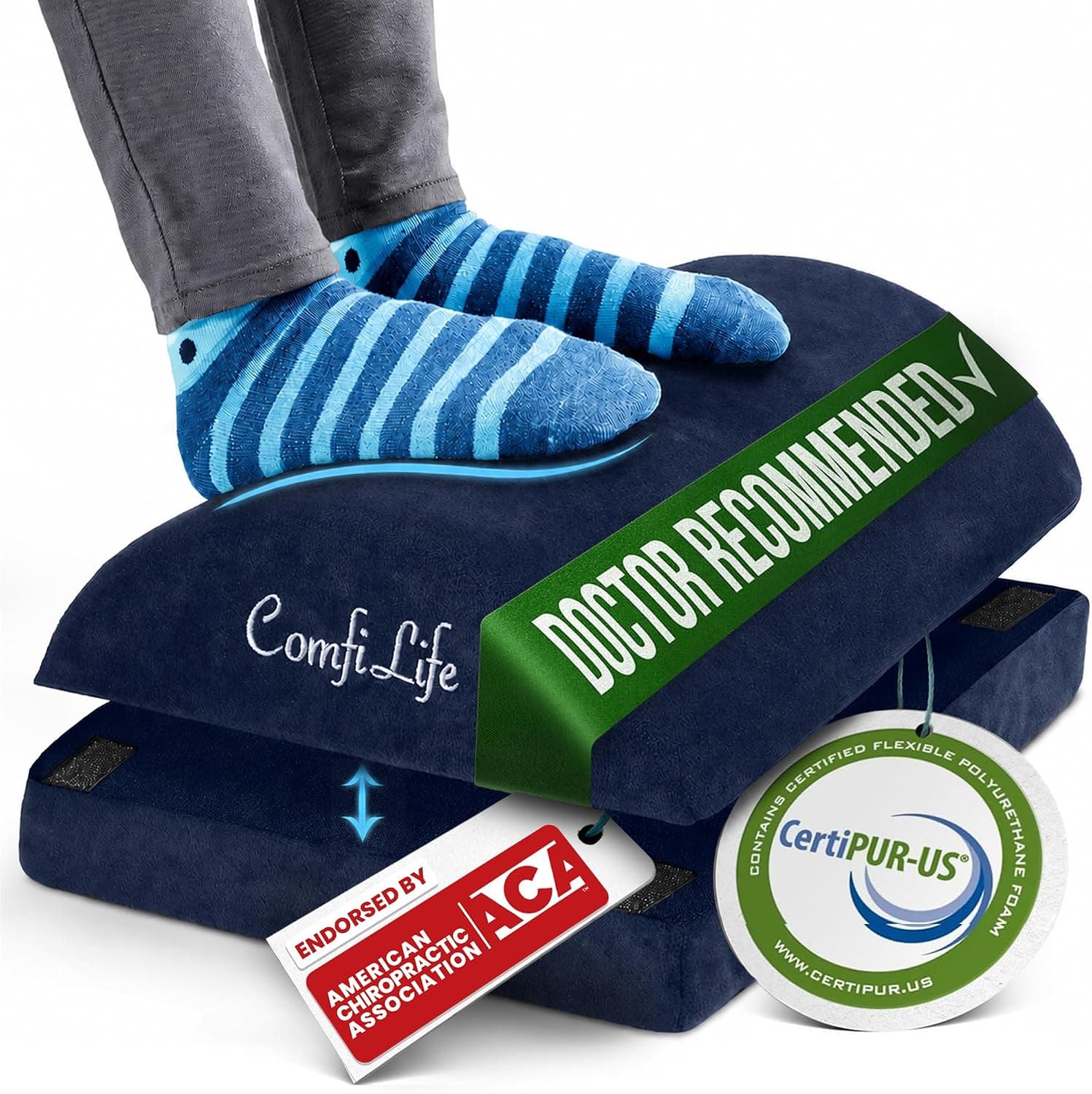 Best adjustable
An adjustable footrest with telescoping legs and a slight tilt option — useful when your chair's lowest setting still leaves a gap between feet and floor.
Best for: People who hot-desk, share a workspace, or use multiple chairs.
- +Height range covers most desk-chair combinations
- +Removable cover is machine washable on many units
- +Lightweight enough to move between rooms
- −Plastic frame feels less premium than solid foam blocks
- −Adjustment knobs need occasional re-tightening
Side-by-side comparison
| Feature | Foam footrest | Adjustable footrest | Dual-height footrest |
|---|---|---|---|
| Typical price | $30 – $40 | $35 – $45 | $30 – $40 |
| Height adjustment | Fixed — one profile | Telescoping legs | Flip between two heights |
| Encourages movement | Textured surface only | Some models rock slightly | Dual sides + tilt options |
| Setup | Slide under desk — instant | Adjust legs once | Flip or adjust once |
| Best if you… | Want simple, proven comfort | Share desk or chair heights vary | Get restless legs during long sessions |
The verdict
Start with the Everlasting Comfort footrest if you want the simplest fix for dangling feet. Upgrade to ComfiLife when height needs to change between users or chairs. HUANUO is the budget-friendly pick with two height levels — all three beat buying a new chair before you know whether desk height is the real issue.
Advertisement
Ad placement activates after cookie consent.
FAQ
Footrest or lower the chair?+
Lower the chair first if you can while keeping elbows near 90 degrees at the desk. If feet still do not reach the floor at the lowest safe chair height, add a footrest. Often you need both adjustments.
Is a footrest worth it for tall desks?+
Yes on fixed-height tables, kitchen counters converted to desks, and standing-desk stools used for perching. Any setup where the seat height is dictated by the surface rather than your body likely needs a footrest for shorter users.
How thick should a foam footrest be?+
Match your measured floor-to-foot gap. Most shorter workers land between 4 and 7 inches of effective height. Adjustable models cover that range; fixed foam blocks often sit around 5 inches.
Can a footrest replace lumbar support?+
It helps indirectly. Proper foot support lets you sit back against the chair instead of perching forward. It does not replace a chair with good lumbar contour if the chair itself is wrong for your back.
Related guides
Keep reading
Published 2026-07-05 · Updated 2026-07-26