Buying Guide · 8 min read
Best Writing Desk for Small Apartments (2026)
Compact writing desks for bedrooms, studios, and shared living rooms — measured picks with shallow depth, useful storage, and one fold-away option.

This guide is a decision framework. Shortlist stays small so you can skip anything that fails desk depth, noise, or budget. How we research.
Some links may earn a commission at no extra cost to you. Dimensions and prices are approximate; verify the current listing before ordering.
Bottom line for apartment writing desks
For most small apartments, the best writing desk is not the narrowest product you can find. It is the smallest desk that still lets your forearms rest, your laptop sit at a usable distance, and your chair pull in without striking a drawer. Around 31 to 40 inches wide and 15 to 20 inches deep is the practical range for one laptop or one modest monitor.
Choose the Lufeiya if floor depth is the hard limit and you still need drawers. Choose the Furinno Econ when supplies, a keyboard, and a router need permanent homes. Choose the XBurmo when the room must stop looking like an office after 5 p.m.
Measure the complete working zone, not only the desktop. Add roughly 30 inches behind the front edge for a chair and your body. A 16-inch-deep desk can still require a 46-inch strip of room once someone is seated.
What size desk actually fits a small apartment?
Start with painter's tape on the floor. Mark the desk width and depth, then place your chair inside the outline and sit down. Open nearby doors, drawers, and wardrobe panels. This five-minute test catches the problem that product photos hide: a desk may fit the wall while making the path to the bed unusable.
A 31- or 32-inch desk is enough for a 13- to 16-inch laptop, a mouse, and a drink. It becomes tight when you add a full-size keyboard, notebook, speakers, or an external monitor. A 39- or 40-inch desk gives those items more breathing room but may dominate a bedroom wall. Depth matters just as much. Fifteen to sixteen inches is excellent for writing and laptops, but a monitor on its stock stand can sit too close to your eyes.
For an external screen on a shallow top, use a compact monitor stand or a wall mount rated for your wall construction. Do not clamp a heavy monitor arm to thin particleboard unless the manufacturer permits it; a reinforcement plate can spread the load, but it cannot turn a weak top into solid wood.
Writing desk, computer desk, or console table?
Retail labels are inconsistent. A writing desk usually means a simple top with open legroom and perhaps one or two drawers. A computer desk may add a keyboard tray, shelves, cable openings, or a tower bay. A console table is often the shallowest and best-looking option, but many consoles are too high or too weak for eight-hour workdays.
Judge dimensions and structure rather than the category name. Standard desk height is usually around 28 to 30 inches. The Lufeiya listing is taller than some standard desks, so shorter users may need a footrest or a chair that raises high enough to keep elbows near desk level. The XBurmo sits closer to conventional desk height and keeps the underside open.
A keyboard tray like the Furinno's can rescue a shallow top because the monitor and keyboard occupy different depth planes. The tradeoff is lower knee clearance. Measure from the floor to the bottom of the tray, not merely to the top of the desk.
Storage helps only when it stays reachable
Small-apartment furniture often advertises maximum storage, but every cabinet consumes either legroom or visual space. For a daily workstation, prioritize one shallow drawer for chargers and pens, then move archives, printer paper, and rarely used accessories elsewhere. A desk should support active work, not become the apartment's filing cabinet.
The Lufeiya's fabric drawers keep small items out of sight with little weight. They are suitable for cables, stationery, and notebooks, not dense files. The Furinno adds more vertical storage, which is useful when wall width is available but floor depth is not. Its open shelves also mean objects remain visible, so matching bins can keep the workstation calmer.
The folding XBurmo has no storage by design. Pair it with one portable work box or rolling cart that can move away with the laptop. This is often more realistic in a dining area than attaching organizers to a desk that must fold flat.
Ergonomics on a 16-inch-deep desktop
Shallow desks create two common posture problems: the screen sits too close, and forearms hang without support. A laptop-only setup works best when you use a compact external keyboard and elevate the laptop. Place the keyboard near the front edge with enough space to rest the heel of the hand lightly, then push the laptop back until the display is comfortable.
If you use a monitor, a 24-inch screen is generally easier to place on a shallow desk than a 32-inch screen. Keep the top third of the display near eye level and avoid turning the head toward a screen parked off-center because storage occupies the middle. Our guides to laptop stands and monitor arms cover elevation options, but the safest solution depends on the desk top and wall.
Feet should stay flat or on a footrest, shoulders relaxed, and elbows near a right angle. If the desk is too high, raising the chair without supporting the feet simply moves discomfort from shoulders to thighs. Compact furniture does not excuse poor fit; it makes accurate fit more important because there is less room to improvise.
Apartment setup mistakes to avoid
Do not place a desk directly against a radiator, baseboard heater, or the only air return. Heat can damage electronics and block room circulation. Leave space for plugs and cable bends; a desk that exactly matches the wall recess may crush power cords behind it.
Avoid buying a desk before measuring the delivery path. Check the apartment door, elevator, stair turn, and final room doorway. Flat-pack desks usually solve this problem, but a preassembled folding frame still has a fixed folded width and height.
Do not let open shelves become a substitute for decluttering. A narrow desk surrounded by visible bins can feel larger and messier than a plain table. Keep daily gear within reach and move occasional supplies to closed storage.
Finally, protect rental floors and walls. Add felt pads under feet, use a chair mat appropriate for the flooring, and confirm lease rules before drilling for shelves or monitor mounts. Adhesive cable clips can remove paint when pulled incorrectly, so test in a hidden spot.
Buying checklist, returns, and how we picked
Record maximum width, depth, chair clearance, and nearest outlet before shopping. List gear that stays on the surface daily — a 27-inch monitor plus keyboard on a 31-inch top usually fails even when the footprint fits the wall.
Check listed height (Lufeiya runs taller than some 28-inch norms), keyboard-tray knee clearance on Furinno, and whether XBurmo locks flat without wobble on your floor.
Read return policy before assembly: repacking particleboard tops after discovering height mismatch is miserable. Keep flat-pack cartons until one full workweek passes.
We filtered Amazon listings near 40×16 inches max, verified live ASINs, and rejected variants whose default size drifted. Lufeiya targets drawers, Furinno vertical storage, XBurmo fold-away — not three copies of the same generic frame.
Choose the compromise that matches the room: hidden storage, visible shelves, or nightly fold-down. No apartment desk is zero-tradeoff; the win is livable space that still supports focus.
Side-by-side comparison
| Feature | Lufeiya 31.5-inch | Furinno Econ | XBurmo folding |
|---|---|---|---|
| Typical price | $55 – $75 | $55 – $70 | $65 – $85 |
| Width × depth | 31.5″ × 15.7″ | 39.4″ × 15.8″ | 31.5″ × 15.7″ |
| Storage | Two fabric drawers | Tray, shelves, and bin | None |
| Moves easily | Yes — lightweight | No — assembled unit | Yes — folds flat |
| Best if you… | Need drawers in minimum depth | Need storage more than mobility | Share the room after work |
Examples that match the criteria
Optional examples that illustrate the criteria above — not a mandatory shopping list. Skip any pick that fails desk depth, budget, noise, or return logistics.
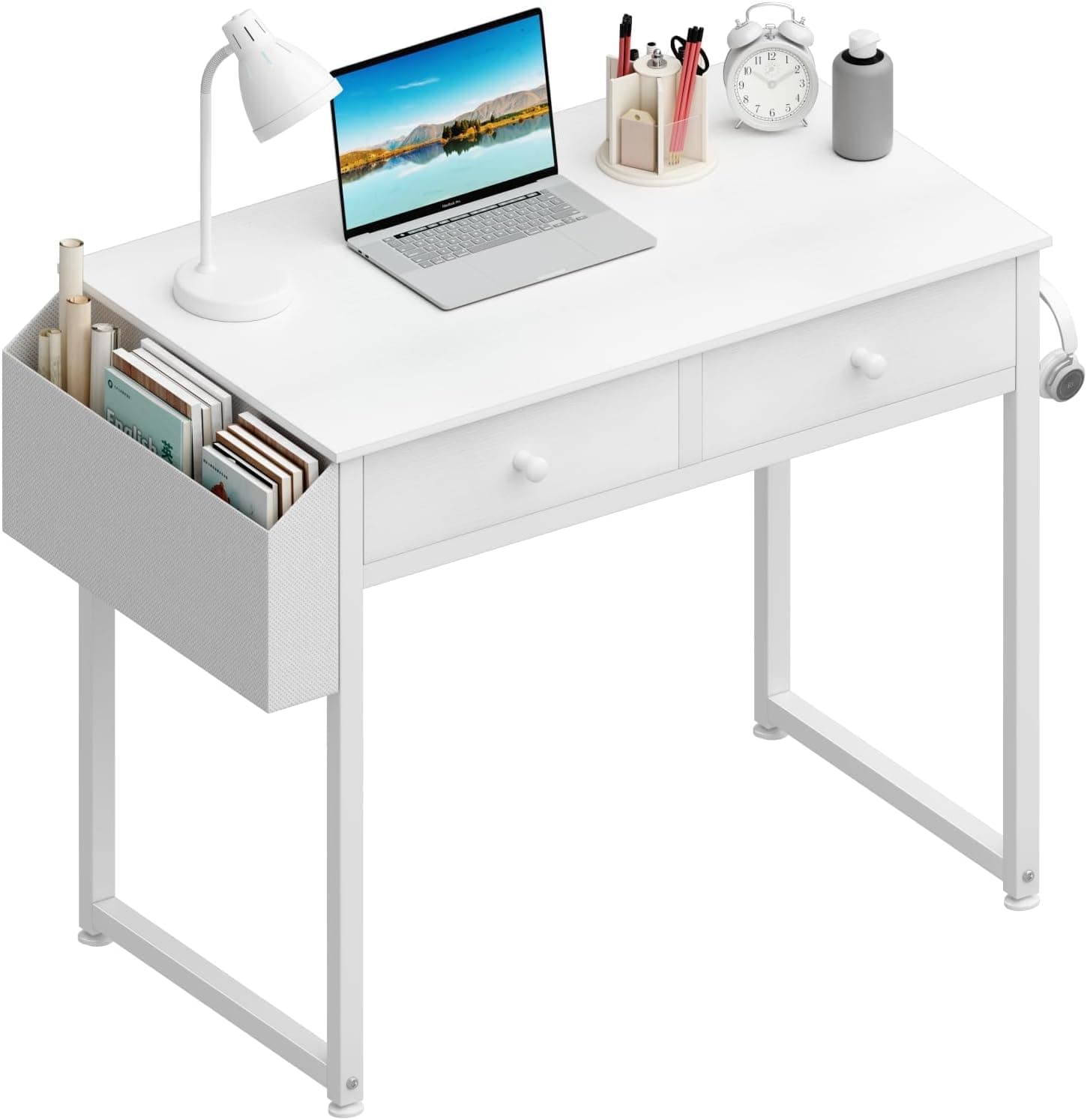 Best overall
A 31.5-inch-wide, 15.7-inch-deep writing desk with two fabric drawers and a slim metal frame. It gives a laptop worker actual closed storage while using less floor depth than many console tables.
Best for: Studio apartments, bedroom offices, and students who need drawers but can dedicate only a narrow wall.
- +15.7-inch depth fits narrow bedrooms and living-room walls
- +Two drawers hide chargers, notebooks, and daily supplies
- +Lightweight frame is easier to reposition than cabinet desks
- −31.5-inch width suits a laptop better than dual monitors
- −Fabric drawers feel less substantial than wood runners
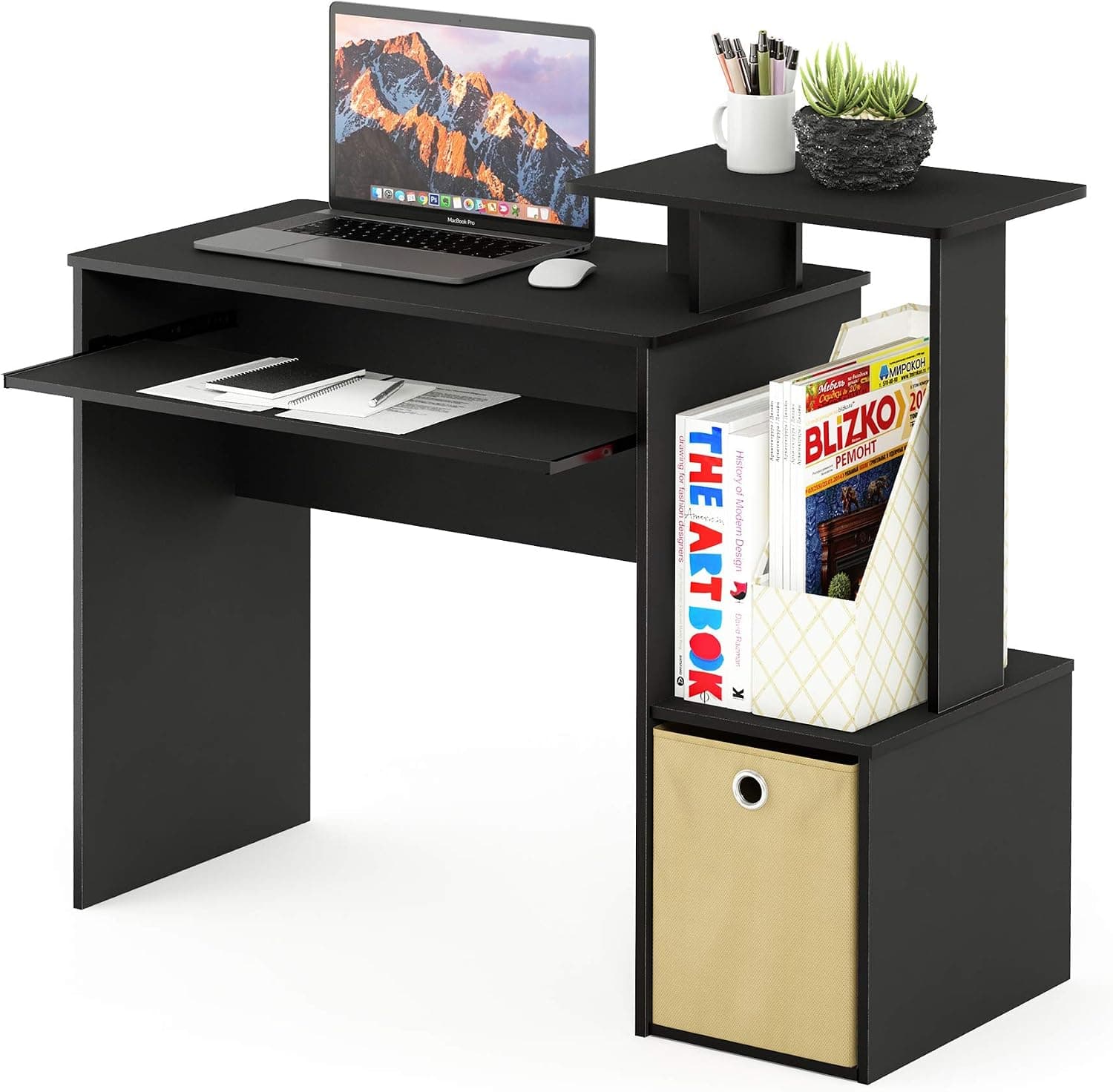 Best storage
A 39.4-inch-wide workstation with a slide-out keyboard tray, side shelves, and a non-woven storage bin. The desktop stays shallow at about 15.8 inches while the vertical structure creates more places for a router, books, and supplies.
Best for: Apartment workers who need a compact computer station with storage and do not plan to fold or move it every week.
- +Uses vertical space instead of adding floor depth
- +Keyboard tray preserves the small main work surface
- +Side shelves and bin reduce the need for a separate drawer unit
- −More assembly and visual bulk than a simple writing table
- −Composite construction needs careful tightening to avoid wobble
The verdict
Buy the Lufeiya 31.5-inch desk when you need the smallest practical footprint plus hidden storage. Choose the Furinno Econ when shelves and a keyboard tray matter more than a clean silhouette. Pick the XBurmo only when folding the office away is the defining requirement. Measure the seated zone, not just the wall, and match the desk to the equipment that must stay out every day.
FAQ
Is a 31-inch desk wide enough to work from home?+
Yes for one laptop, compact keyboard, mouse, and a small notebook. It is usually too narrow for dual monitors or a large monitor plus open paperwork. Tape out the exact dimensions and arrange your current gear inside the outline before buying.
How deep should a writing desk be for a small apartment?+
Fifteen to twenty inches works for writing and laptop use. External monitors often benefit from 20 to 24 inches unless you use a low-profile stand or wall mount. Remember to include chair clearance behind the desk in the room measurement.
Are foldable desks stable enough for daily work?+
They can be stable enough for a laptop and normal typing when locked open on a level floor. They are less suitable for heavy desktop towers, aggressive monitor-arm clamps, or equipment that must remain precisely positioned.
Should a small desk have drawers?+
Choose drawers if small visible objects repeatedly distract you. Skip them if they reduce knee room or make the desk harder to move. A portable work box or slim rolling cart can provide storage without attaching it to the desk.
Can I use a console table as a writing desk?+
Only if its height, depth, strength, and leg clearance suit seated work. Many consoles are taller than desks and have support rails that hit the knees. Test the dimensions against your chair before treating a decorative table as an all-day workstation.
Related guides
Keep reading


Published 2026-07-22 · Updated 2026-08-09